
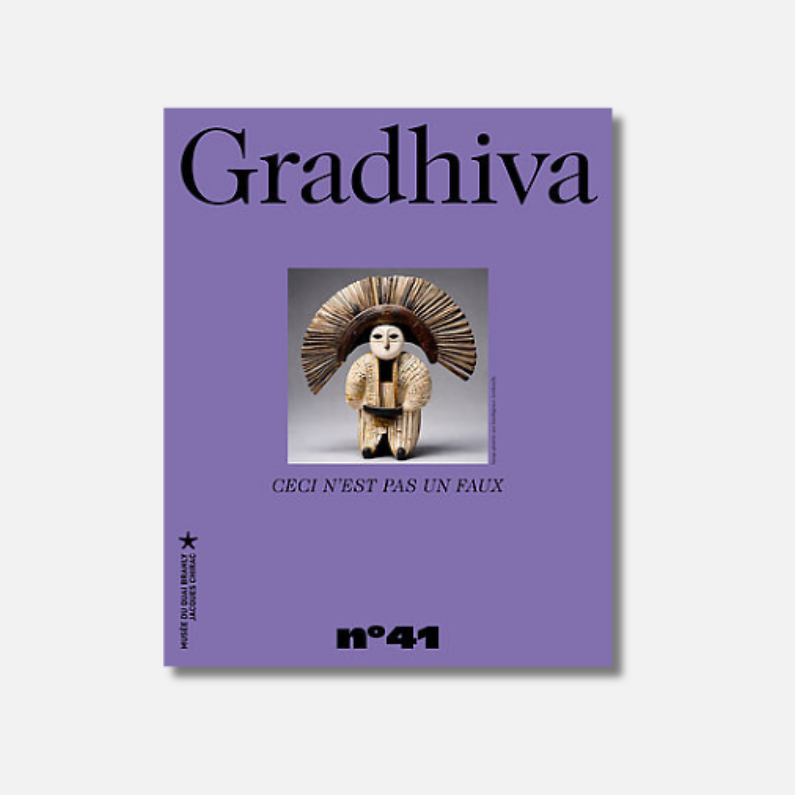
Book - Gradhiva No. 41: This Is Not a Fake
Description
What makes an object, a place, a work of art, or an identity authentic? At a time when artificial intelligence is transforming our relationship with truth and falsehood, this volume offers an original exploration of a concept far more complex than it may seem. Rather than focusing on detecting misinformation, it examines how societies construct, negotiate, and assign authenticity.
Through a multidisciplinary and comparative approach, this issue highlights the many dimensions of authenticity: artworks created for the non-European art market, pilgrimage sites, miraculous objects, legal documents, Indigenous rituals, copies, imitations, digital reconstructions, and even counterfeit currency. Each contribution reveals the cultural, social, and symbolic mechanisms that shape our understanding of what is genuine.
What narratives, techniques, and power dynamics contribute to the making of authenticity? What questions of legitimacy, memory, and value lie behind this pursuit? By bringing together perspectives from multiple disciplines, this volume invites readers to rethink a concept that lies at the heart of contemporary debates and to question the meaning we continue to attribute to it today.
An essential volume for researchers, students, and curious readers seeking to understand the cultural, political, and social issues surrounding authenticity in a world where the boundaries between original, copy, and counterfeit are becoming increasingly blurred.
Product information
- Technical specification
Dimensions: 24.1x30.1x1.0cm
Author(s): Isabel Yaya McKenzie, Cécile Guillaume-Pey, Emanuela Canghiari
Publisher(s): Musée du quai Branly
Date of publication: 2026/05/06
Number of pages: 151
Contains illustrations: Yes
- EAN
- 9782357441729